For those who've tried therapy, read all the books, and still wake up anxious
How a Psychologist Survived War Without "Processing Trauma" — And Why That Changes Everything You Think You Know About Healing
The 14-day method that works when years of therapy, meditation apps, and positive thinking have failed
Let me be direct.
If self-help worked, you wouldn't be here.
Therapy is a powerful tool, but let's be honest: not everyone is in a place—mentally, emotionally, or financially—to commit to years of deep diving into the past. And while self-help books offer great ideas, they often fail when real-life pressure hits. You don't need another 'vague' theory; you need a practical bridge between where you are and where you want to be.
You've read the books. Listened to the podcasts. Maybe spent thousands on therapy sessions where you dissected your childhood, analyzed your patterns, and understood exactly why you are the way you are.
And yet...
You still wake up with that knot in your stomach. The anxiety that never fully goes away. The feeling that no matter how much you "work on yourself," something fundamental is still... broken.
Here's what nobody tells you:
Understanding why you're stuck doesn't unstick you.
I know this not just as a licensed psychologist who's spent 15 years in practice.
I know this because when my life shattered in 2022 — when I lost my home, my safety, people I loved — all my training, all my degrees, all those years helping clients...
They didn't help me.
What did help was something completely different. Something I'd never taught. Something that goes against everything the self-help industry tells you to do.
And it worked in 14 days. Not 14 months. Not 14 sessions of therapy.
14 days.
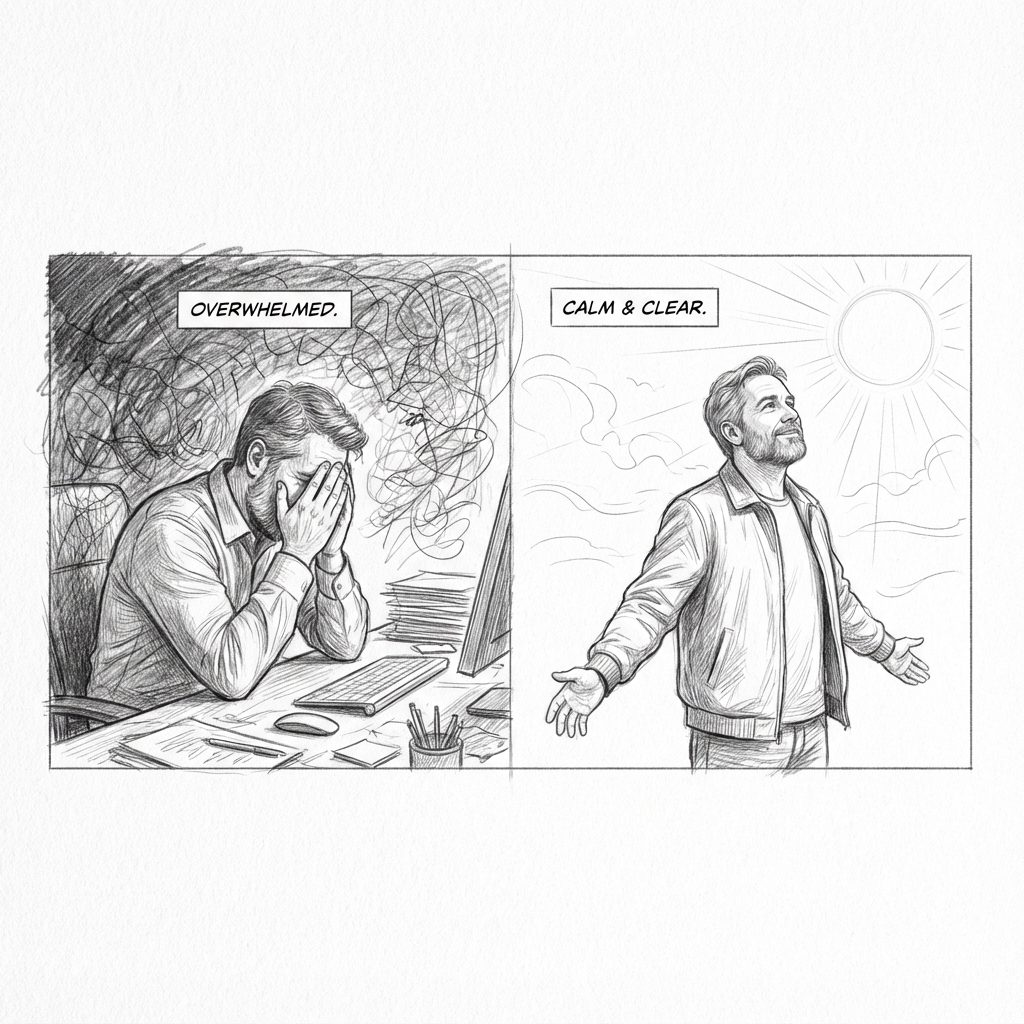
Let me paint a picture of your reality.
Tell me which one hits home:
If it's about your divorce...
You're not just "getting over it." You're fighting lawyers who seem designed to drain you dry. You're navigating custody battles where your kids become weapons. You lie awake replaying every year, thinking: "Was it all for nothing? Did I waste the best years of my life?"
And the worst part? You can't trust anyone anymore. Every new person feels like a potential betrayal waiting to happen. The humiliation of explaining why your marriage failed. Again. And again.
If it's about money...
You're exhausted from living in permanent tension. Every dinner out, every grocery trip — you're calculating, checking prices, feeling that familiar knot in your stomach. The credit card statements. The calls you don't answer. The shame of saying "I can't afford it" one more time.
It's not even about being poor. It's about the constant, grinding stress that colors everything. You can't relax. You can't breathe. You can't plan for a future because you're too busy surviving today.
If it's about your health...
Feeling bad has become your baseline. The headaches. The fatigue. The way your body just... hurts. And you've gotten so used to it that you don't even complain anymore. You just smile and say "I'm fine" while everything inside you is quietly screaming.
You've seen doctors. Tried supplements. Changed your diet. And nothing really changes. So you've accepted this: life just feels... heavy. All the time.
If it's about anxiety...
It's not dramatic panic attacks (though sometimes it is). It's the constant hum of dread underneath everything. The overthinking that steals your sleep. The way you rehearse conversations that will never happen. The paralysis when you need to make decisions.
You've missed opportunities because fear whispered "what if." You've damaged relationships by sabotaging them before they could hurt you. You've made yourself small because being visible feels dangerous.
And you're so tired of living like this.
Sound familiar?
What You've Already Tried (And Why It Didn't Work)
Here's the thing. You're not lazy. You're not broken. You've actually tried really hard.
You've tried self-help: Atomic Habits, The 7 Habits, Brené Brown, all the Instagram wisdom. It made sense when you read it. But when real life hit, the advice evaporated.
You've tried therapy: Maybe for months. Maybe years. You understood your patterns, traced them back to childhood, got insights. But somehow, you still felt the same.
You've tried meditation and mindfulness: Headspace, Calm, YouTube videos. It helped... until the anxiety came roaring back the moment you opened your eyes.
You've tried "taking action": Journaling, gratitude lists, affirmations, vision boards. Worked for two weeks. Then life happened and they all fell apart.
Some of it helped. For a while. But somehow, you always end up back in the same place.
The same thoughts. The same feelings. The same struggle.
And every time something doesn't work, you blame yourself a little more.
"Maybe I'm just not disciplined enough."
"Maybe I'm not trying hard enough."
"Maybe I'm just... unfixable."
No. That's not it. The problem isn't you.
The Fatal Flaw in Everything You've Been Taught
Here's what therapy teaches you:
"Understand your trauma. Process your emotions. Resolve your past."
Here's what self-help teaches you:
"Think positive. Visualize success. Replace negative thoughts with positive ones."
Here's what mindfulness teaches you:
"Let go. Accept. Be present."
They all sound different. But they share one fatal assumption:
That you need to GET RID of difficult emotions to feel better.
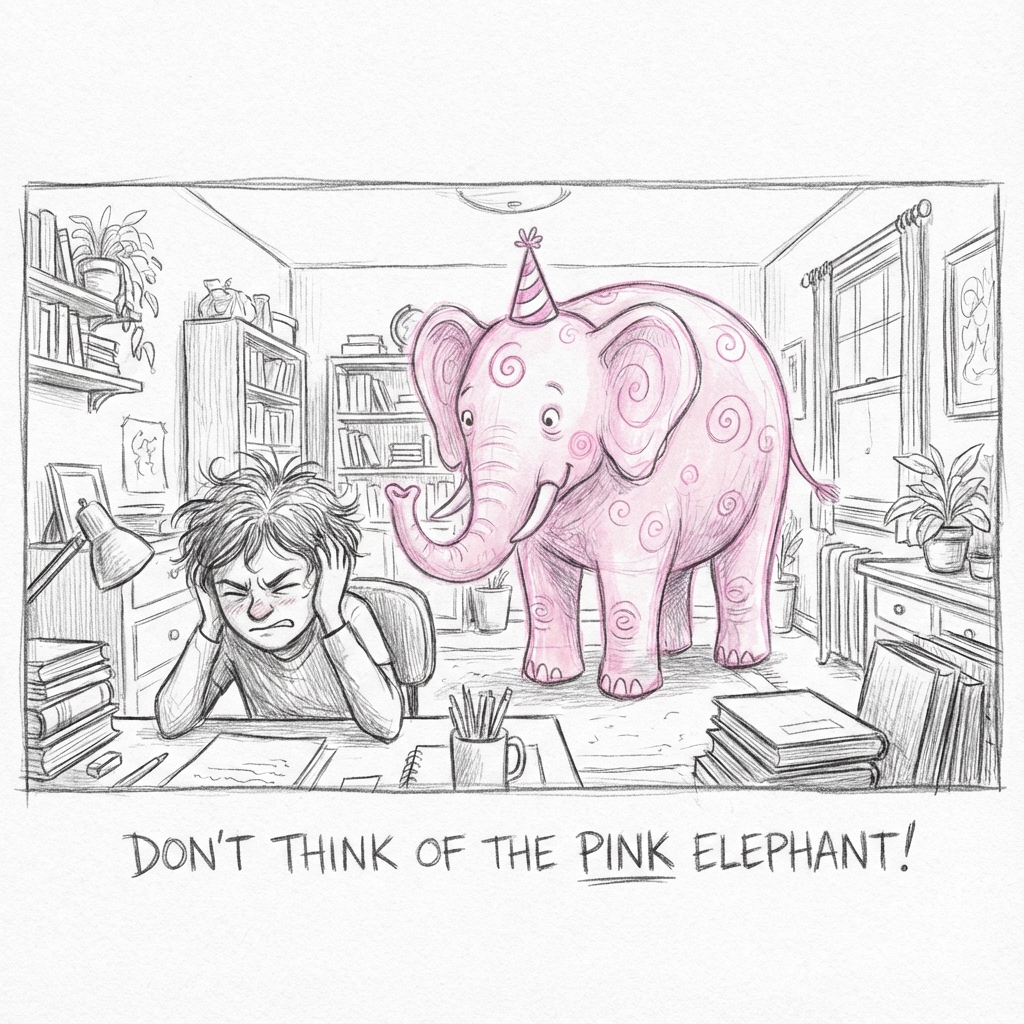
Try this right now: For the next 10 seconds, do NOT think about a pink elephant.
What
happened?
The moment you try to suppress a thought, it gets stronger. This isn't willpower failure. It's neuroscience.
When you fight anxiety, it fights back harder.
When you try to "process" trauma, you often retraumatize yourself.
When you force positive thinking, your brain notices the gap between your thoughts and reality — and
feels worse.
This is why nothing worked.
Not because you're weak. But because you were using the wrong tool entirely.
February 24, 2022: When Everything I Knew Stopped Working
I woke up to explosions. Within hours, war had reached my city in Ukraine.
My home. My practice. My sense of safety. People I loved. Gone or scattered.
I'm a psychologist.
And none of it prepared me for this.
In those first weeks, I tried everything I'd been trained to do:
- Processing my emotions through journaling
- CBT techniques to challenge catastrophic thinking
- Mindfulness to stay present
- Reaching out for support
Nothing worked. The fear was too big. The grief was too heavy. The uncertainty was unending.
I felt like a fraud. What kind of psychologist can't even help herself?
And then, in week three, something shifted.
Not because I found a new coping technique. Not because I "processed" my trauma.
But because I stopped trying to make the pain go away.
The Realization That Changed Everything

Here's what I finally understood:
The problem wasn't the fear, the grief, or the uncertainty.
The problem was my war against
them.
Every time I tried to "fix" my emotions, I reinforced the belief that I was broken.
Every time I fought the anxiety, I made it stronger.
Every time I told myself I "shouldn't" feel this way, I added shame on top of pain.
What if I just... stopped fighting?
What if I let the fear be there — and kept moving anyway?
What if grief could ride alongside me without driving the car?
This isn't positive thinking. It's not about pretending everything is fine.
It's about fundamentally changing your relationship with difficult emotions.
I started practicing this. Five minutes a day. Then ten. Then fifteen.
Within two weeks, something remarkable happened:
The heaviness began to lift. Not because the war ended. Not because my situation improved. But because I stopped fighting myself.
Because I didn't just 'survive'—I acted. Using these exact skills, I found the clarity to secure funding, navigate complex logistics, and move my family to safety in record time. But here is the most important part: once the adrenaline faded and the immediate danger passed, I didn't collapse. I didn't fall into survivor's guilt, bitterness, or emotional numbness. I was ready to live, to love, and to build a new future immediately. This method didn't just save my life; it saved my soul from the emptiness that usually follows a crisis.
This is called psychological flexibility.
I just didn't realize how powerful it was until I had to use it to save my own life.
The Adaptive Mind Method
What I discovered isn't new. It's based on decades of peer-reviewed research.
But it's been locked away in academic journals and $200/hour therapy offices.
I call it The Adaptive Mind Method.
It's built on three core principles:
1. ACCEPTANCE (Not Avoidance)
Stop fighting your emotions. Learn to let them be present without letting them control you.
2. FLEXIBILITY (Not Rigidity)
Develop the ability to see situations from multiple angles instead of getting stuck in one painful perspective.
3. VALUES-BASED ACTION (Not Fear-Based Reaction)
Act according to what matters to you — even when fear, grief, or pain are present.
How It's Different:
OLD APPROACH:
Situation → Painful feeling → Fight it → Feel worse → Give up
ADAPTIVE MIND:
Situation → Painful feeling → Notice it → Make space → Act on values
The difference isn't what you feel. It's what you DO with what you feel.
Why This Works (When Everything Else Hasn't)
What do we often think:
"I've tried acceptance. It doesn't work for me."
What you tried wasn't acceptance — it was resignation or suppression in disguise.
Real acceptance is active, not passive. It means "I feel this pain AND I'm still moving toward what matters" — not "I give up."
Research shows acceptance-based approaches are more effective than suppression across anxiety, depression, PTSD, and chronic pain. (Hayes & colleagues, 2006 meta-analysis of 60+ studies)
- You stop wasting energy fighting yourself
- Emotions lose their power over your decisions
- You can act effectively even when you feel terrible
"But I need to understand WHY I feel this way."
Understanding is useful, but it's not what creates change.
You can understand every childhood wound and still be stuck. Insight ≠ transformation.
- You don't need months of excavating the past
- Changes happen in weeks, not years
- You become self-sufficient instead of dependent on endless therapy
"This sounds too simple. My problems are complex."
Complex problems don't always need complex solutions.
Surgery is complex. But washing your hands to prevent infection? Simple. Yet that simple act saves more lives.
Psychological flexibility works across ALL diagnoses — anxiety, depression, trauma, eating disorders, chronic pain. That's why it's so powerful.
- One skill set handles multiple problems
- No need to diagnose yourself or find the "right" therapy
- Works for everyday stress AND major life crises
The Research (For Those Who Need Proof)
This isn't just my story. The science is overwhelming:
| 4 days of practice | 30-40% reduction in anxiety symptoms | (Istanbul University Medical School, 2025) |
| 6 weeks | 2-3x improvement in quality of life measures | (Berlin Psychiatric Clinic study, 2024) |
| 2+ years later | Maintained protection during major life crises | (Netherlands adolescent COVID study, 2023) |
| 20-30 min/month | 1.9x improvement in workplace wellbeing | (McKinsey organizational study, 2021) |
But here's what numbers don't show: Real people who finally feel free.
Sarah, 34: "Two years of therapy helped me understand why I felt broken after my divorce. This method helped me feel whole — in two weeks."
Michael, 42: "I still have debt. But I can breathe. I can sleep. I can be present with my kids instead of drowning in panic."
Jennifer, 29: "I learned I could stay connected to my toxic family without absorbing their chaos. I didn't know that was even possible."
Why This Succeeds Where Therapy and Self-Help Fall Short
I'm a therapist. I believe in therapy.
But therapy has blind spots. And self-help has limitations. Here's the truth:
Traditional Therapy: A vital, deep-dive process that requires significant time and emotional energy. Ideal for long-term healing when you have the resources to commit.
Self-Help Apps: Great for temporary motivation, but often lack the clinical depth needed for lasting change.
The Adaptive Mind: A high-speed skill set for those who need to function and thrive now. It's the "mental survival kit" for when you can't afford to wait months for relief.
Think of it this way:
Therapy is like going to a restaurant. The chef (therapist) prepares insights for you. It's nourishing, but you can't do it yourself.
Self-help is like watching cooking shows. Entertaining, inspiring, but you're still hungry after.
The Adaptive Mind Method is like learning to cook. You get the recipes, the techniques, the practice. Then you can feed yourself for life.
What Exactly Do You Need To Do?
You don't need complex rituals, deep self-analysis, or a total lifestyle overhaul. All it takes is 5 to 15 minutes of practice following a clear, step-by-step algorithm.
See how to turn theory into a practical skill you can use every day.
The Truth is, You Don't
Need More Information. You Need
a Skill.